Pupillary distance (PD)
What is PD?
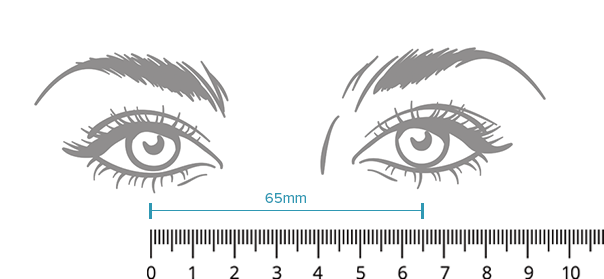
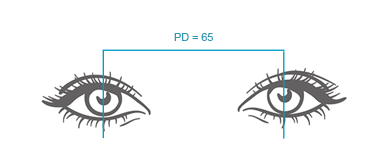
PD stands for Pupillary Distance , which is the measurement of the distance between the center of one pupil and the center of the other. Your PD is an important factor because it indicates where you look through your eyeglass lenses and should be as accurate as possible. For people with high prescriptions, this is especially important.
Typically, you can find your pupillary distance (PD) on your eye prescription. Generally, the PD for adults remains the same over time. The average pupillary distance for men is 64 mm , while the average PD for women is 62 mm . For children, the average PD is between 43 and 58 mm .
What does PD mean for eyeglasses?
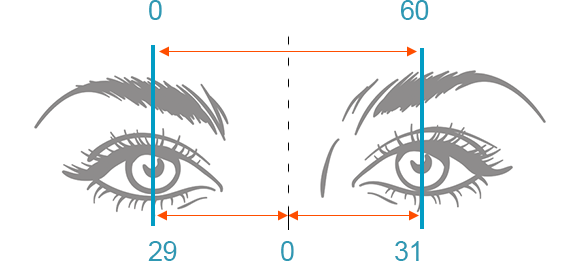
- Binocular PD is indicated as a single number, for example “63” , which represents the total distance between the center of your pupils.
- Monocular PD is the distance from the center of the bridge of the nose to each pupil, measured separately for each side. It is indicated by two numbers, usually around 30 mm, such as 31 and 32 .
- In some cases, PD is indicated as “61/58” .
- 61 is your distance PD , used for single-vision, bifocal, and progressive lenses.
- 58 is your reading PD , used only for single-vision reading glasses.
(Reading PD is typically about 3 mm smaller than distance PD, as the eyes move closer together when reading.)
Keep in mind that PD (Prescription Dysphoric Vertebrate) isn't always listed on your prescription after an eye exam. If it's not included, don't worry— we can help .
How to measure PD and PD checker
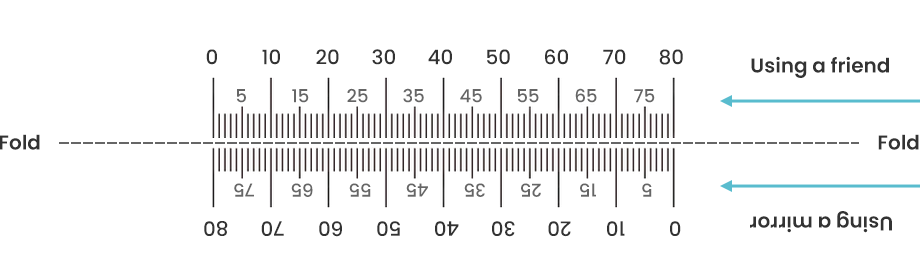
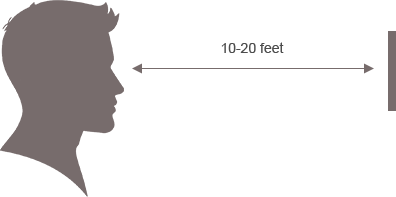
Measuring your PD (pupillary distance) can be easily done at home, especially with the help of a friend or family member. If you are wearing glasses, remove them and look at an object that is 3 to 6 meters (10–20 feet) away.
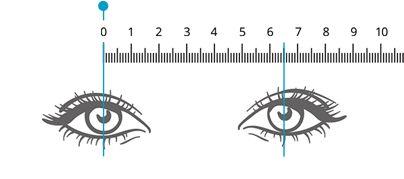
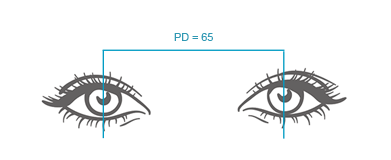
Ask a friend to measure your PD.
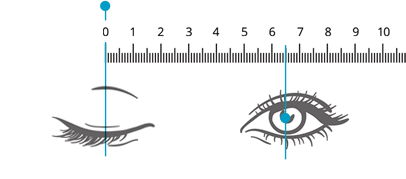
Ask your friend to hold the PD ruler in front of their eyes, placing the zero mark in the center of their right pupil . Read the measurement. The number directly over the center of their left pupil is their PD .
Ask your friend to repeat the measurement a few times to ensure the value is correct.
PD measurement with PD tools
It's also easy to measure your PD yourself . All you need is a PD ruler and a mirror .
- Fold the PD ruler so that the side marked "use with mirror" faces outward.
- Stand about 20 cm (8 inches) away from a mirror.
- Hold the ruler in front of your eyes, keeping the zero mark aligned with your left pupil .
- Close your left eye and open your right eye, looking straight ahead. The number directly above your right pupil is your PD ( posteroanterior vertex).
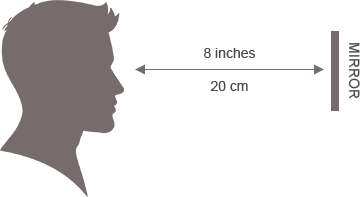
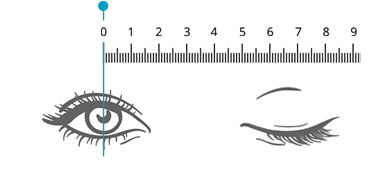
Notice:
For reading glasses, you can subtract 3 mm from your PD measurement.
For more information, please consult our guides .
PD ruler for printing
Print the PD ruler at 100% scale . Do not use the "fit" or "scale" options. The print setting should be actual size .
After printing, measure the ruler with a millimeter ruler to ensure the printout is correct.